
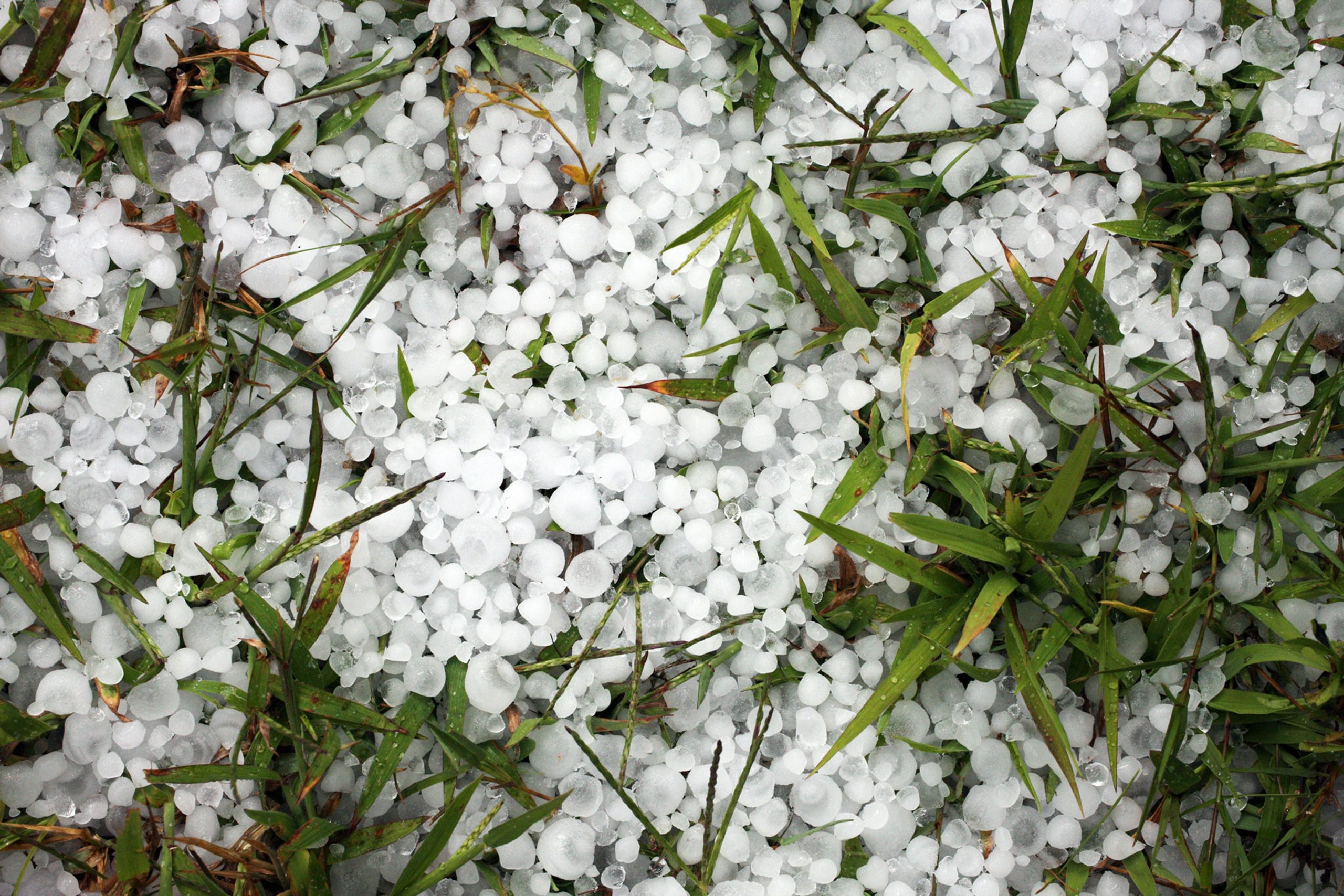
Photo by David Trinks on Unsplash
A recent study from the Red&Blue project, conducted by the Institute for Environmental Studies (IVM) at VU Amsterdam, explores how advanced data analytics can improve the understanding of hailstorm risks in the Netherlands. The scientific manuscript, titled “Hailstorm prediction and loss assessment using high-resolution hazard and claims data” has been published in Atmospheric Research.
The study looks at hailstorms that occurred in the Netherlands between 2010 and 2019, using detailed insurance data from a Dutch financial conglomerate. By combining this information with radar estimates of hail size (MEHS), weather station records, and large-scale climate data, the study examines the spatial and temporal characteristics of hailstorms and their associated damages. The findings show that bringing together different types of data can lead to a clearer picture of hail risk and help improve future loss predictions.
Hailstorm Insights
At the core of the analysis lies the MEHS metric, which estimates hailstone size based on radar signals. By comparing MEHS values with recorded losses, clear relationships between hail size and damage intensity are identified. A MEHS threshold of 1.5 cm (roughly the size of a marble) provides the most reliable indicator of damage occurrence when data is aggregated at the one-digit postal code level.
These results indicate that the hail size estimates can effectively describe the hail climatology of the Netherlands, outlining where and when hailstorms are most likely to occur and how severe they tend to be.
Defining the hailstorm’s characteristics is essential for improving both the hailstorm evaluation and risk modelling for insurance. Understanding the spatial distribution of hail events allows for more accurate estimation of regional risk and supports the development of preventive strategies for agriculture and infrastructure.
Machine Learning Identifies Key Predictors
To improve predictive capabilities, the study applies random forest models, a widely used machine learning technique that can handle complex nonlinear relationships, to the meteorological datasets. These models were trained using ERA5 reanalysis data, which provide consistent and detailed atmospheric information across space and time.
The random forest analyses highlighted several key variables associated with hail formation. Convective-related parameters such as convective inhibition (CIN) and convective available potential energy (CAPE) emerged as the most influential predictors of hail occurrence. Less commonly, other variables such as dewpoint temperature and precipitation were also found to improve model accuracy.
The performance of the models is promising. When predicting the occurrence of hail days, the models achieved high accuracy. When refined to identify days with hail large enough to cause significant damage, performance remained robust.
Although the models are not trained to estimate hail intensity, they effectively identified the likelihood and frequency of damaging hail events. Further refinement could allow future models to predict not only hail occurrence but also the severity of impacts.
Implications for Climate Adaptation and Risk Management
Beyond its technical achievements, the study offers important insights for risk management and climate adaptation. Hailstorms, though often localized and short-lived, can cause millions of euros in damage each year.
By linking physical meteorological data with financial loss records, the research provides a foundation for developing more accurate risk models that can inform both insurers and policymakers. These models can help forecast potential losses, guide premium setting, and support farmers and municipalities in strengthening their resilience.
A Data-Driven Future for Hailstorm Risk Assessment
Overall, the study highlights the potential of combining modern data science techniques with meteorological observations and empirical loss data to improve hazard prediction and risk evaluation. By integrating radar-derived Maximum Expected Hail Size (MEHS) data, atmospheric reanalysis variables, and loss records, the study develops a comprehensive framework for analyzing hailstorm dynamics and their impacts.
As extreme weather patterns continue to evolve under a changing climate, such models could play a vital role in forecasting hail events, reducing uncertainty, and strengthening resilience strategies across the agricultural and financial sectors.
The full manuscript can be found here.
For more information, contact María Fonseca Cerda – m.d.s.fonseca.cerda@vu.nl


