
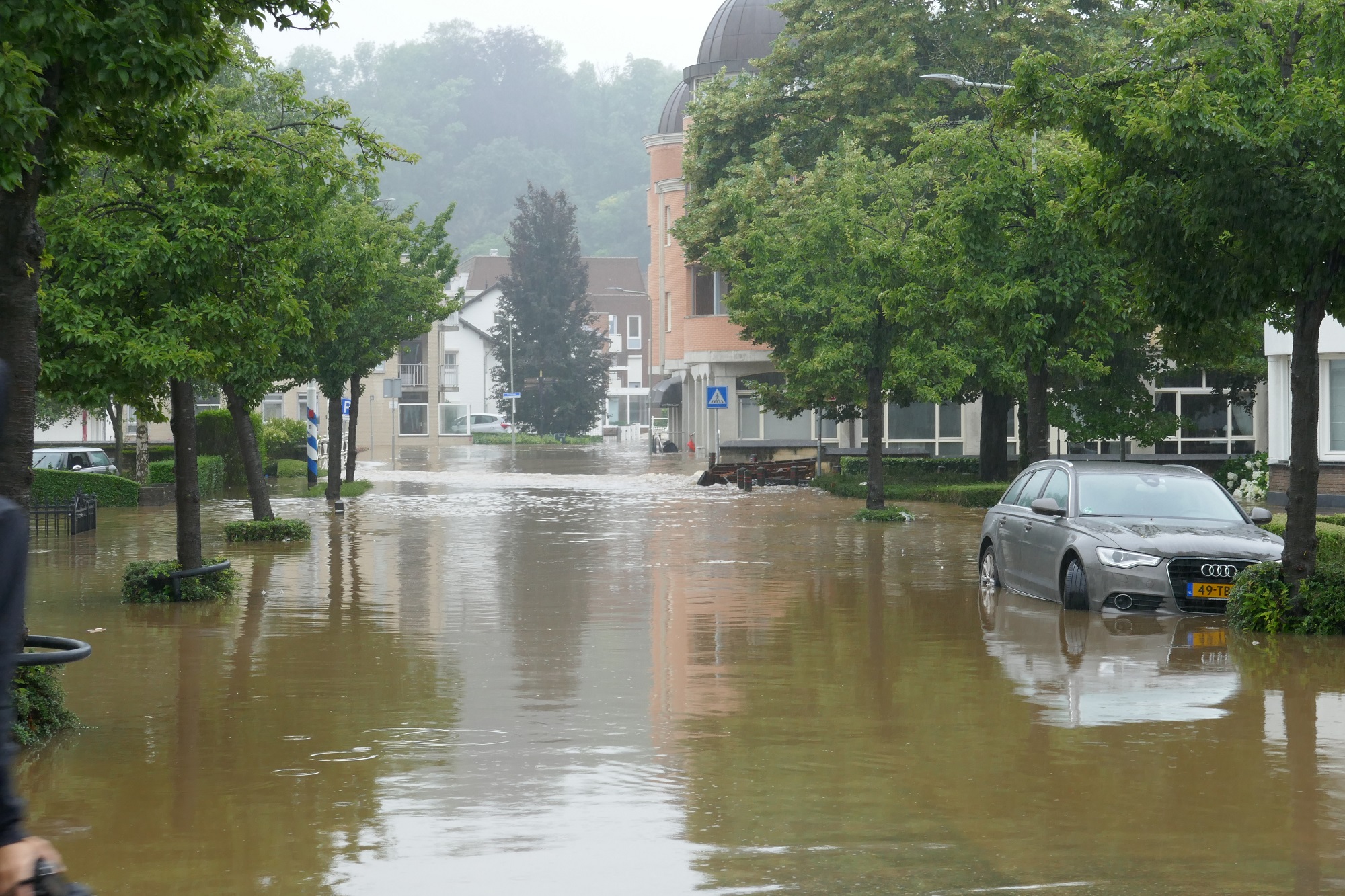
Insurers can play a significant role in encouraging weather related damage reduction in businesses through early warnings and information. This is the main take away from the recently published article by Vylon Ooms, Policy Advisor Climate Change at the Dutch Association of Insurers.
He is pursuing a Ph.D. at the Institute for Environmental Studies at VU University Amsterdam, researching how insurers can prevent and decrease damage from extreme weather through climate adaptation.
The first article, Assessing the drivers of flood risk reduction actions of businesses, has been published. What exactly did you study?
“We investigated the risk-reducing behavior of businesses in terms of reducing flood damage. We did this by building on previous research on private households and a recent survey conducted by VU University with over 200 companies (SMEs) in the region affected by the 2021 floods in Limburg. We examined five factors influencing entrepreneurs’ behavior: being insured for floods, timely warnings, information provision, risk perception, and experience with flooding. This was combined with four forms of climate-adaptive measures: emergency measures, structural measures, future plans to implement measures, and the willingness to relocate. To assess the relationships between all these data points, we performed regression analyses.”
Why did you choose to focus on SMEs?
“The choice was based on an event with scientists and insurers on climate change. It became clear that preventing damage through damage reduction measures is one of the most important themes for insurers. Given the increase in extreme weather and the 2021 floods, that makes sense. At the same time, little is known in the scientific field about SMEs and flood risk, even though 99.9 percent of Dutch companies belong to this group, according to CBS (Statistics Netherlands).”
What are the key findings?
“Businesses appear to be highly motivated to take risk-reducing measures. There is no evidence of moral hazard, where companies take fewer precautions because they expect compensation for flood damage by insurers or governments. Additionally, businesses that receive timely warnings are significantly more likely to implement emergency measures. Companies that proactively sought information about their flood risk before the flooding also took (significantly) more often structural measures. Moreover, companies located in flood-prone areas took (significantly) more frequently risk reduction measures.”
“Businesses were also asked whether they would relocate if floods became more frequent. These answers were compared with results of private households. Interestingly, businesses have a higher risk perception than households but are less likely to consider relocation. Even if a flood like the one in Limburg would occur five more times by 2050, 58 percent of businesses will certainly not move. For households, this is only 21 percent.”
What conclusions do you draw from the results?
“The results show that insurers and advisors can truly make a difference by providing information on flood risks and issuing timely warnings to better prepare their customers. Previous VU research by Climate Finance Academy-colleague Thijs Endendijk also shows that these measures can prevent 30 to 40 percent of damage. This means that taking measures reduces damage, and providing information and early warnings effectively leads businesses to take action.”
And what’s your next step?
“I will carry these conclusions into my follow-up research on strategies that insurers can use to engage clients to use climate adaptation to prevent damage. I am particularly curious about strategies that are truly effective, or combinations potentially in collaboration with other parties or stakeholders. That is the overarching aim.”
“This year, I will focus on a different sub-theme, namely climate adaptation in public spaces and the dissemination of information to citizens to reduce damage caused by extreme rain events. I will use Amsterdam as an example. The city has developed many climate adaptation projects through Amsterdam Weatherproof to prevent and decrease damage from extreme rainfall. In my next study, I will compare rain damage in an area of Amsterdam where climate adaptation measures have been implemented with a similar area in the city where no measures have been taken. This way, by controlling for many variables, I will assess whether municipal climate adaptation measures result in less damage from rainfall.”
Would you like to know more? You can find the paper here:
Assessing the drivers of flood risk reduction action of businesses

Vylon Ooms – v.ooms@verzekeraars.nl


