
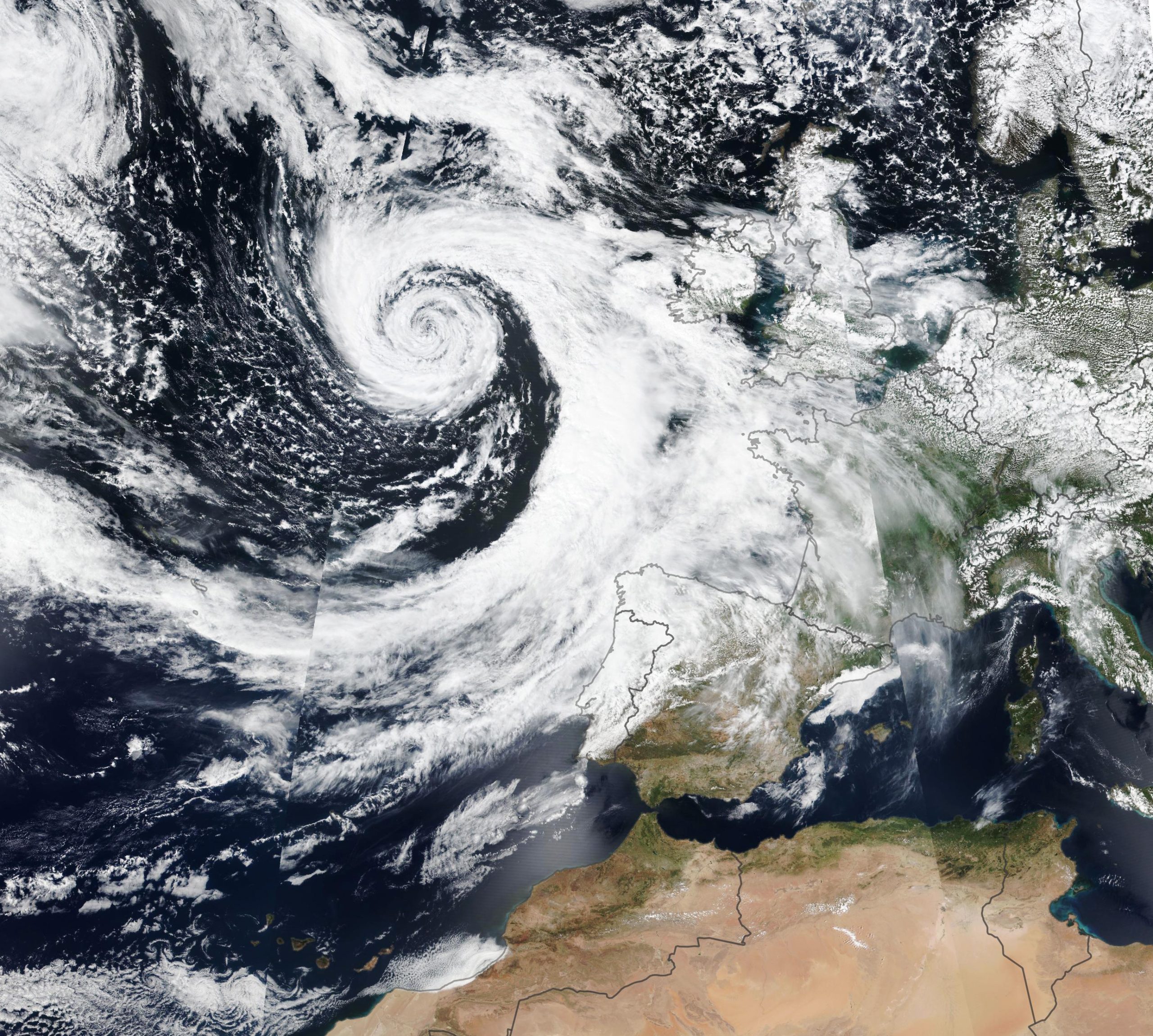
Photo: NASA Earth Observatory image by Lauren Dauphin, using VIIRS data from the Suomi National Polar-orbiting Partnership
It’s impossible to ignore any longer: our climate has changed, is changing, and will continue to do so as long as we keep emitting greenhouse gases and engaging in large-scale deforestation [1]. These climate changes are leading, among other things, to an increase in extreme weather worldwide. This is also the case in the Netherlands, where winter storms, for example, are becoming wetter.
Consequently, these climate changes present new challenges for the insurance and reinsurance sector. They must correctly assess the changing climate risks to appropriately set insurance premiums and financial buffers. In the Netherlands, some insurers (and other financial institutions) are strengthening their ties with the academic world to better understand these changing climate risks. My employer (Achmea) is one of them, having joined the Climate Finance Academy in 2023. This is a research group focused on climate-related risks, organized by the Institute for Environmental Studies (IVM) at the Vrije Universiteit Amsterdam. The research group includes, among others, climate scientists, (environmental) economists and econometricians, behavioral scientists, and civil engineers. It focuses on both fundamental and applied issues related to climate risks for financial institutions. Such an interdisciplinary approach is perfectly suited to the requirements for understanding and managing complex climate risks.
Vulnerability functions for Winter Storms
Within this partnership, we have conducted research over the past year on damage functions, also known as vulnerability functions in the literature, for winter storm damage to residential buildings. This has resulted in a successful publication in the scientific journal npj Natural Hazards (Nature Portfolio). Below, we will briefly explain the content of this study and how it can contribute to climate-adaptive insurance.
Natural Catastrophe Models
Vulnerability functions describe the relationship between the intensity of these storms and the damage to an affected home. This intensity can be measured in various ways; for winter storms, the wind gust speed that hits a property is often considered. These types of vulnerability functions are part of a broader natural catastrophe model. This model can calculate the economic or insured losses from events like storms, floods, or earthquakes. Insurers and reinsurers then use these results to determine insurance premiums and to establish their financial buffers. In addition to vulnerability functions, a natural catastrophe model also includes a hazard and an exposure module. The hazard module describes the characteristics of the natural hazard: are we dealing with a storm or a flood, where and how often does it occur, and what damage-driving mechanisms does it produce? The exposure module contains all the information about the assets for which the damage is to be calculated. In the case of residential buildings, this includes the location of the property, its type, construction materials, year of construction, or other characteristics that make it vulnerable to the natural hazard being studied. The risk resides at the intersection of these three modules (hazard x exposure x vulnerability) [3].
From a scientific perspective, developing these vulnerability functions is interesting because the necessary damage data are often unavailable to academics. Insurers, however, possess this type of information in the form of insurance claims data. This is a great example of how industry, in turn, can enrich science. For insurers, developing their own vulnerability functions is also useful because it reveals a significant part of the ‘black box’ that natural catastrophe models often represent to them. Almost every insurer purchases these models from third parties and, accordingly, does not have complete insight into their workings. While there are, of course, many good reasons why purchasing this expertise is advantageous, such as cost-efficiency, the lack of full transparency complicates model validation, flexible model deployment, and, to some extent, accountability to legislators and regulators. Nevertheless, it also creates a dependency on quantitative climate knowledge that can hinder the development of in-house expertise, which nowadays is strongly encouraged by legislators and regulators [4].
Incorporating Climate Change into Vulnerability Functions
Developing vulnerability functions in-house also provides the opportunity to experiment with methods that are better suited to the changing climate. For instance, we know that winter storms are becoming wetter, meaning they produce more rain [5,6]. It is therefore important that natural catastrophe models can incorporate such developments to arrive at accurate damage estimates. This is especially true when these models are used to run climate scenarios, i.e. future projections of the climate and associated (extreme) weather generated by climate models. Despite the observed and expected changes in this type of storm, conventional vulnerability functions often do not account for rainfall dynamics.
In our study, we have created vulnerability functions that are capable of doing so. By linking hundreds of thousands of weather-related insurance claims to meteorological data from the Royal Netherlands Meteorological Institute (KNMI), and then considering various combinations of variables and their transformations, we estimated a large number of specifications for vulnerability functions using beta regressions. Based on a model-fit criterion, we then selected the “best” vulnerability function specification. It turned out that rainfall dynamics contain undeniably valuable information for explaining and predicting damage to a home resulting from a winter storm [2]. A recent trend in academic literature focuses on describing the risks resulting from the convergence of multiple weather- and/or climate-related events. Specifically, research is examining combinations whose impact is greater than the sum of their individual impacts, which are referred to as compound weather and climate events [7]. The models we have developed are therefore part of a new generation of compound vulnerability functions.
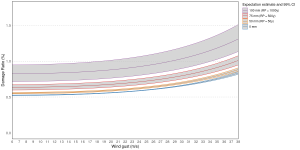
Our studies also show that when a vulnerability function cannot account for these rainfall dynamics, the damage to a residential building is underestimated during storms with extreme amounts of precipitation: from a 24-hour cumulative rainfall of 50 mm (~ a return period of 50 years [8]) onwards, the underestimation can reach tens of percent. To adjust the insurance premiums and financial buffers of insurers to the increasing climate risks—in other words, to keep insurance climate adaptive—these types of rainfall dynamics must therefore be taken into account.
Want to learn more? Find the scientific article here or contact Daan van Ederen d.van.ederen@vu.nl
References
[1] IPCC, (2021): Climate Change 2021: The Physical Science Basis. Contribution of Working Group I to the Sixth Assessment Report of the Intergovernmental Panel on Climate Change [Masson-Delmotte, V., P. Zhai, A. Pirani, S.L. Connors, C. Péan, S. Berger, N. Caud, Y. Chen, L. Goldfarb, M.I. Gomis, M. Huang, K. Leitzell, E. Lonnoy, J.B.R. Matthews, T.K. Maycock, T. Waterfield, O. Yelekçi, R. Yu, and B. Zhou (eds.)]. Cambridge University Press, Cambridge, United Kingdom and New York, NY, USA
[3] Kron, W. (2005). Flood risk= hazard• values• vulnerability. Water international, 30(1), 58-68.
[4] DNB (2023). Gids voor de beheersing van klimaat- en milieurisico’s
[5] KNMI (2023): KNMI’23klimaatscenario’s voor Nederland, KNMI, De Bilt, KNMI-Publicatie 23-03.
[6] KNMI (2025): De staat van ons klimaat 2024;
[7] Zscheischler, J., Martius, O., Westra, S., Bevacqua, E., Raymond, C., Horton, R. M., … & Vignotto, E. (2020). A typology of compound weather and climate events. Nature reviews earth & environment, 1(7), 333-347.
[8] STOWA. (2019). Neerslagstatistiek en-reeksen voor het waterbeheer 2019 (STOWA Rapport 2019-19).


